
Origins of Imbolc
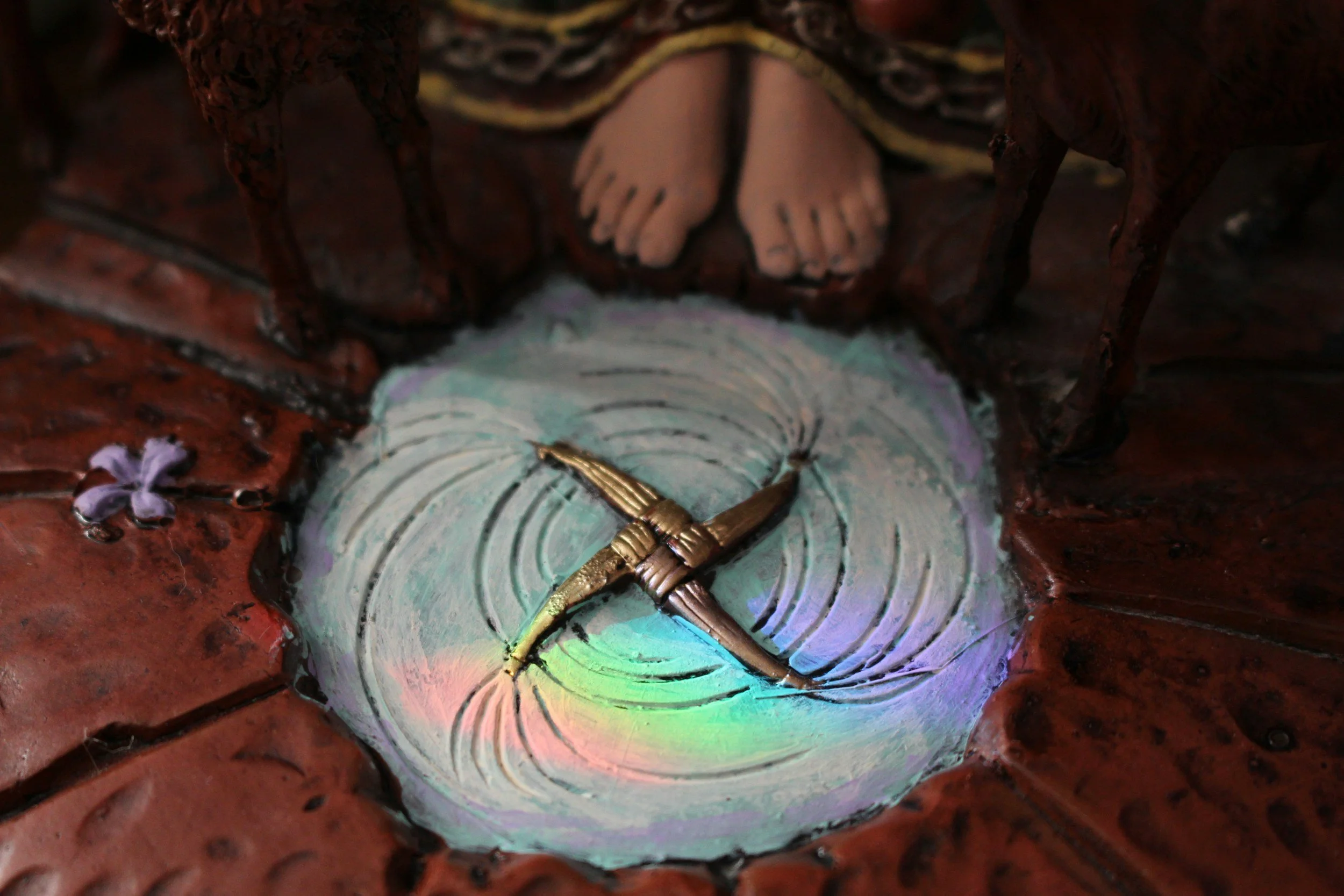
Imbolc marks the midpoint between the winter solstice and the spring equinox and is traditionally understood as the beginning of spring itself. The days are perceptibly lengthening; the dominance of night is slowly loosening its grip as the year turns toward light. In Irish Neopagan tradition, Imbolc is also the feast of the goddess Brigit, a figure whose later Christian counterpart, St. Brigit, remains strikingly goddess-like even in her medieval vitae. In reconstructionist traditions, her Gallo-Brittonic forms—Brigantia or Brigindona—are likewise honored at this time, aligned with the Feast of St. Brigit on February 1.
Yet alongside Imbolc’s associations with spring and Brigit lies a third, often overlooked dimension: purification. Evidence suggests that Imbolc functioned not merely as a single feast day, but as part of a broader seasonal period of cleansing, analogous to other Indo-European—and later Christian—rites of purification. Far from being separate meanings, spring, Brigit, and purification are deeply entwined and together illuminate the festival’s origins.
The etymology of Imbolc strongly supports this interpretation. While early sources such as Sanas Cormaic (c. 900) interpreted the word as oímelc (“sheep’s milk”), Eric Hamp has demonstrated that this spelling likely reflects a misunderstanding of an older form, ommolg, derived from a Proto-Indo-European root meaning both “milk” and “to cleanse.” Milk, then, was not merely nourishment but a purifying substance. Irish literature reinforces this symbolism: milk cures poisoned wounds, sanctifies land, and in one striking tale, purifies even dung. These stories suggest an underlying belief in milk’s cleansing power.
Purification also appears explicitly in medieval references to Imbolc. A poem preserved in Rawl. B 512 and Harl. 5280 describes Imbolc as a time of ritual washing of hands, feet, and head. Notably, the poem does not emphasize specific foods—unlike other feast days—hinting that milk’s role here may have been less culinary than symbolic, functioning as a cleansing agent aligned with the season’s themes.
Brigit herself embodies this convergence of purity, nourishment, and renewal. In the Bethu Brigte, six of her forty-six miracles involve milk, underscoring both her purity and her authority over a vital economic resource. Milk repeatedly marks Brigit as sacred: she is nourished by a mystical white cow when ordinary food is deemed impure, a motif shared with other Irish saints. Alongside milk, Brigit is closely associated with fire—another purifying force. Medieval sources describe flames rising from her dwelling, fiery pillars above her head, and her perpetual, ashless fire tended by women alone. Though folk etymologies of her name as “fiery arrow” are linguistically incorrect, they nevertheless reflect a longstanding perception of Brigit as a goddess—or saint—of brightness and cleansing fire.
These themes resonate beyond Ireland. The Roman month of February, contemporaneous with Imbolc, was itself a period of purification, named for the februa, goatskins used in the rites of Lupercalia. This festival combined purification and fertility: blood was wiped from initiates’ foreheads with wool soaked in milk, and women were ritually struck with goatskins to promote conception. Juno, the presiding goddess—closely associated with childbirth, cattle, and light—was honored at this time and sometimes depicted wearing the februum. The parallels to Brigit are striking: both goddesses oversee fertility, cattle, childbirth, and purification through light, fire, and milk.
Christian observances echo this same seasonal logic. Lent, derived from the Old English lencten (“spring”), typically begins in February and represents a prolonged period of fasting and purification during the leanest time of the year. Candlemas, celebrated on February 2 as the Feast of the Purification of the Virgin Mary, likewise centers on ritual cleansing, though its origins lie in Mosaic law rather than direct pagan inheritance. While Candlemas did not derive from Imbolc, its placement within a wider constellation of February purification rites—pagan and Christian alike—suggests a shared seasonal impulse rather than coincidence.
Even the Coligny calendar may reflect this pattern. If aligned with an Irish-style year beginning at Samhain, the Gaulish month Anagantios, likely meaning “ablutions,” would correspond to February, reinforcing the idea of a pan-Celtic period devoted to washing and purification rather than a single ritual day.
Taken together, linguistic evidence, myth, ritual practice, and cross-cultural parallels point to Imbolc as more than a simple celebration of spring or a feast of Brigit alone. It marks a threshold: a time when nourishment returns, light increases, and bodies, land, and spirit are ritually cleansed in preparation for renewal. Milk, fire, and water—Brigit’s elements—bind these meanings together, revealing Imbolc as a festival of purification at the turning of the year.