Inanna
She comes to you barefoot.
Not the soft-lit oracle version.
Not the Pinterest altar version.
Inanna comes with dust in her teeth and gold still warm from someone else’s worship.
She is the hum beneath your ribs when you are tired of being good.
She was a queen, yes.
She had the crown, the jewels, the men who wrote poems about her hips and called it devotion. She had the temples. She had the sky.
And still she wanted more.
Not more applause.
More truth.
So she walked toward the underworld like a woman who knows that comfort is a leash.
At the first gate, they asked her to remove her crown.
She did not argue.
At the second, her necklace.
At the third, her breastplate.
At the fourth, her rings.
At the fifth, her cosmetics.
At the sixth, her robe.
At the seventh—
everything.
They left her naked and hanging.
This is where most of us turn back.
But you don’t.
Because you are tired of the performance too.
You are tired of pretending the marriage is fine.
Tired of pretending the job is purpose.
Tired of pretending your hunger is unbecoming.
Inanna did not descend because she was broken.
She descended because she was powerful enough to survive seeing herself without decoration.
That is the ritual.
Not the incense.
Not the moon water.
Not the curated shadow-work captions.
The ritual is removal.
Take off the smile you use when you want to be liked.
Take off the voice you use when you don’t want to scare anyone.
Take off the story that says you are “too much.”
Hang there for a while.
Feel how quiet it is without applause.
Feel how solid your bones are without approval.
In the underworld, no one cares if you are impressive.
Only if you are real.
And when she rose—
oh, she rose—
she did not come back polite.
She came back exact.
She came back knowing that desire is holy.
That anger is information.
That grief is not weakness but depth.
She came back with dirt under her nails and a gaze that said:
I have seen what I am without the gold.
I am not afraid.
That is the month with Inanna.
A month of stripping.
A month of hanging.
A month of rising.
Not prettier.
Not nicer.
But undeniable.
And somewhere between the fifth gate and the seventh,
when you are sure you have lost everything—
you will feel it.
Not ego.
Not performance.
Power.
It does not shout.
It stands.
Bare.
And does not flinch.
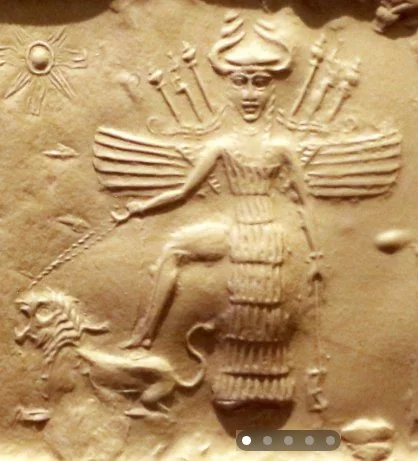
Inanna is one of the most ancient and complex goddesses, rooted in Sumerian tradition but carrying echoes from even older mountain and cosmic mythologies. Described by the priestess Enheduanna as wearing “the robes of the old, old gods,” Inanna embodies a lineage that stretches back to the earliest divine forces of heaven and earth. As the goddess of Venus — both Morning Star and Evening Star — she represents duality from the beginning, a unifying figure who connects heaven, earth, and the underworld. Over time, Inanna absorbed powers from other deities, eventually rising above them as a central, magnetic force in Mesopotamian spirituality — a goddess who gathered chaos, contradictions, and cosmic forces into one powerful presence.
What makes Inanna especially compelling is her embodiment of opposites. She is a goddess of love and fertility, but also war, destruction, and raw, uncontrollable power. In myth, she descends into the underworld, seeks authority beyond her realm, and returns transformed, carrying both darkness and light. Inanna reflects the full range of human nature — beauty and terror, tenderness and violence, creation and ruin — becoming a mirror of the soul itself. Her immense popularity in the ancient world likely came from this truth: Inanna did not represent perfection, but wholeness. She was the divine expression of contradiction, the wild feminine that holds everything at once.